
AI strategy consulting that identifies high-value use cases, builds your AI roadmap and governance, and trains your team to adopt AI with confidence.

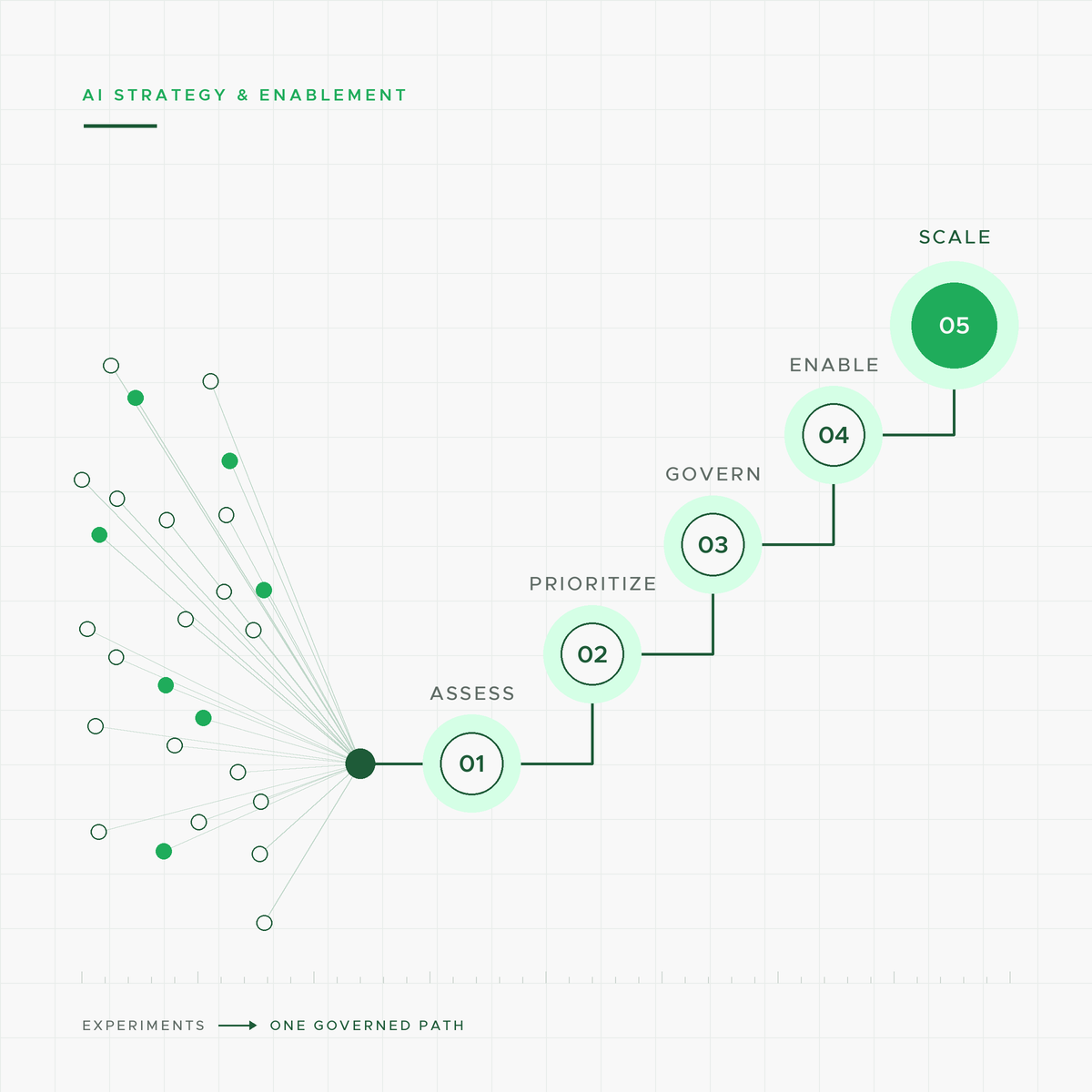


As your consulting and coaching partner, and fractional advisor, my team and I deliver the following expertise to help your business adopt AI with a clear strategy, sound governance, and a team ready to use it:

Evaluating your data, systems, processes, and team capabilities to determine where AI can realistically deliver value today.
Identifying and ranking AI use cases across sales, marketing, operations, and service by impact, effort, and risk.
Quantifying expected costs, time savings, and revenue impact so AI investments are approved on evidence, not hype.
Building a phased plan that sequences quick wins, foundational work, and larger initiatives over the next 90 days to 12 months.
Identifying the data quality, access, and structure gaps that must be fixed before AI can produce reliable outputs.
Defining decision rights, approval processes, and human oversight so AI use stays accountable as it scales.
Writing clear staff guidelines on approved tools, data handling, and where human review is required.
Flagging data privacy, security, and intellectual property risks so legal and compliance questions surface before adoption, not after.
Comparing platforms like ChatGPT, Claude, Gemini, Microsoft Copilot, and built-in CRM AI on fit, security, and total cost.
Facilitated sessions that align leadership on AI priorities, risk tolerance, investment levels, and success metrics.
Role-based training that teaches sales, marketing, and operations teams to use AI tools effectively and safely in daily work.
Creating shared prompt libraries and usage playbooks so AI output quality is consistent across the team, not dependent on individuals.
Equipping internal champions who model good AI use, support their peers, and surface new opportunities from the front line.
Planning communication, ownership, and adoption milestones that move teams from hesitation to confident everyday use.
Defining how AI success is measured, from adoption and time saved to quality and revenue impact, and reviewing it on a set cadence.
Translating the strategy into scoped, prioritized projects ready to build, whether by your team, a vendor, or our implementation services.

Your Current State: Your team has run AI pilots and tool trials, but none have become part of how the business actually operates — each one produced an impressive demo, then stalled without a defined outcome, an owner, or a path to scale.
Example Problem: MIT's 2025 study of enterprise generative AI found that 95% of pilots delivered no measurable impact on profit and loss — and traced the failures to tools that never fit real workflows, not to weaknesses in the AI models themselves.
Desired State: A pilot-to-production framework where every AI initiative starts with a defined business outcome, a baseline to measure against, a named owner, and clear criteria for when to scale, adjust, or stop.
Example Outcome: McKinsey's 2025 State of AI research found that the small group of organizations capturing significant value from AI are nearly three times as likely to have fundamentally redesigned workflows around it — rather than layering AI on top of existing processes.
Your Current State: AI is on every leadership agenda, but there is no shared plan for where it fits in your business — so adoption happens tool by tool and team by team, driven by whoever is most curious rather than by business priorities.
Example Problem: Microsoft and LinkedIn's Work Trend Index found that while 79% of leaders agree AI adoption is critical to staying competitive, 60% worry their organization lacks a vision and plan to implement it.
Desired State: A documented AI strategy and phased roadmap that ties every initiative to a business priority, sequences quick wins ahead of larger bets, and gives leadership one shared view of where AI investment is going and why.
Example Outcome: BCG's 2026 AI at Work research found that clear strategic direction lifts AI's reported impact by 25 percentage points — five times the lift that comes from simply providing better tools.
Your Current State: Promising AI projects keep getting shelved after the proof of concept — because the data, risk controls, costs, and expected business value were never worked out before the build started.
Example Problem: Gartner predicted that at least 30% of generative AI projects would be abandoned after proof of concept by the end of 2025 due to poor data quality, inadequate risk controls, escalating costs, or unclear business value — and its later analysis found the figure reached at least 50%.
Desired State: A stage-gated evaluation process that checks data readiness, risk, total cost, and expected value before any build begins — and makes a deliberate decision on whether to buy, partner, or build.
Example Outcome: MIT's 2025 research found that AI tools purchased from specialized vendors or delivered through partnerships succeeded about 67% of the time, while internal builds succeeded only about one-third as often.
Your Current State: Your customer, sales, and operational data lives across disconnected systems with inconsistent definitions and gaps — and nobody has assessed whether it can support the AI use cases leadership wants to pursue.
Example Problem: A 2024 Gartner survey found 63% of organizations either do not have or are unsure whether they have the right data management practices for AI — and Gartner predicts that through 2026, organizations will abandon 60% of AI projects unsupported by AI-ready data.
Desired State: A data readiness assessment tied to your priority AI use cases — identifying which data is usable today, which gaps must close first, and who owns the quality of each source going forward.
Example Outcome: IBM's 2025 CEO Study found 72% of CEOs view their organization's proprietary data as the key to unlocking generative AI's value — making data preparation the step that turns generic AI tools into a real competitive advantage.
Your Current State: Your employees are already using ChatGPT, Gemini, and other AI tools on their own — with personal accounts, no approved tool list, and no visibility into what company or customer data is being shared.
Example Problem: Microsoft and LinkedIn found 78% of AI users bring their own AI tools to work — rising to 80% at small and medium-sized companies — missing the benefits of strategic AI use and putting company data at risk.
Desired State: A sanctioned AI toolset matched to real job needs, paired with clear usage rules — so employees keep the productivity they have found while the business regains visibility and control.
Example Outcome: ISACA's 2025 AI Pulse Poll found 68% of respondents say AI has already saved time for them and their organizations — value a sanctioned, governed approach keeps without the exposure that comes with unapproved tools.
Your Current State: There are no written rules for how AI should be used in your business — no approved use cases, no guidance on sensitive data, and no defined point where a human must review what AI produces.
Example Problem: ISACA's 2026 AI Pulse Poll found only 38% of organizations have a formal, comprehensive AI policy, while 25% have no AI policy in place at all — even as 90% of respondents believe employees are already using AI.
Desired State: A right-sized AI governance framework and acceptable use policy that define approved tools, data boundaries, decision rights, and human review requirements — written in plain language your team will actually follow.
Example Outcome: McKinsey's 2025 State of AI research found that the organizations capturing the most value from AI are far more likely to have defined processes for when AI outputs need human validation — 65% compared with 23% of other organizations.
Your Current State: Nobody has reviewed how your AI tools handle customer data, confidential documents, or intellectual property — so sensitive information may already be flowing into platforms outside your security team's view.
Example Problem: IBM's 2025 Cost of a Data Breach Report found that high levels of shadow AI added an average of $670,000 to breach costs, and 63% of breached organizations had no AI governance policy in place or were still developing one.
Desired State: A structured risk, privacy, and security review completed before AI tools are adopted — with data classification rules, access controls, and vendor security criteria built into every AI decision.
Example Outcome: The same IBM report found organizations that used AI and automation extensively in their security operations saved nearly $2 million per breach and resolved incidents 80 days faster — showing that AI applied deliberately reduces risk rather than adding to it.
Your Current State: AI tools have been rolled out or tolerated, but your team was never taught how to use them well — so a few power users get real value while most employees either avoid the tools or use them inconsistently.
Example Problem: Microsoft and LinkedIn found only 39% of people who use AI at work have received AI training from their company, and ISACA's 2026 AI Pulse Poll found just 33% of organizations train all employees on AI.
Desired State: Role-based AI training for sales, marketing, operations, and leadership — combining hands-on instruction, shared prompt standards, and coaching so effective use becomes the team norm rather than the exception.
Example Outcome: BCG's 2025 AI at Work survey found 79% of employees who received more than five hours of AI training became regular users, compared with 67% of those who received less.
Your Current State: Leadership talks about AI as a priority, but the team hears mixed messages — with no clear explanation of what AI means for their roles and little visible connection between what leaders say and what the business actually does.
Example Problem: BCG's 2026 AI at Work survey found only a third of frontline employees say leadership's communications about AI are clear, and just 28% see a strong connection between what leaders say and what the organization actually does.
Desired State: An aligned leadership team with a shared AI narrative — clear priorities, visible executive sponsorship, and consistent communication that explains what is changing, why, and how people will be supported.
Example Outcome: BCG found the share of employees who feel positive about generative AI rises from 15% to 55% when they experience strong leadership support.
Your Current State: Part of your team sees AI as a threat to their jobs rather than a tool for their work — so adoption stalls, useful ideas go unshared, and new tools quietly go unused.
Example Problem: A Pew Research Center survey found 52% of U.S. workers feel worried about how AI may be used in the workplace in the future, while only 36% feel hopeful.
Desired State: A structured AI change management plan — with honest communication about what is changing, involvement of the people doing the work, internal champions, and adoption milestones that build confidence over time.
Example Outcome: Prosci's research found 88% of initiatives with excellent change management met or exceeded their objectives, compared with just 13% of those with poor change management — making them nearly seven times more likely to succeed.
Your Current State: The business is paying for AI tools and people say they save time, but nobody can show what that time is worth in revenue, cost, or capacity — which turns every renewal and new AI investment into a debate.
Example Problem: IBM's 2025 CEO Study found only 25% of AI initiatives have delivered expected ROI and only 16% have scaled enterprise-wide — and IBM's executive research found only about 29% of leaders can measure AI ROI with confidence.
Desired State: A defined AI measurement framework — with baselines captured before rollout, adoption and quality metrics, and business KPIs reviewed on a set cadence — so AI investment decisions are made on evidence.
Example Outcome: The same IBM study found 65% of CEOs are now prioritizing AI use cases based on ROI, and 68% report having clear metrics to measure innovation ROI — a shift toward treating AI as an investment with measurable returns rather than an experiment.
Your Current State: Your team is saving real time with AI, but that time is not being redirected anywhere intentional — it gets absorbed by more email, more meetings, and more busywork instead of higher-value work.
Example Problem: BCG's 2026 AI at Work survey found 42% of regular frontline AI users save at least a full workday per week, yet 66% get limited or no guidance on what to do with that time.
Desired State: A plan for reinvesting AI-driven capacity — with clear expectations for where saved time goes, from customer conversations and pipeline growth to strategic projects that were previously out of reach.
Example Outcome: McKinsey's 2025 State of AI research found that while 80% of companies set efficiency as a goal for AI, the organizations seeing the most value also set growth and innovation as objectives.
Your Current State: Leadership assumes AI adoption is still early in your market and there is time to wait and see — while competitors are already using it to respond faster, personalize more, and operate leaner.
Example Problem: Salesforce's Small and Medium Business Trends research found 75% of SMBs are at least experimenting with AI — and while 80% of AI users believe the technology is common among their peers, only a third of non-users agree.
Desired State: A competitive AI assessment that shows where AI is already changing expectations in your market — and a prioritized plan to close the most important gaps first.
Example Outcome: The same Salesforce research found growing SMBs lead AI adoption at 83%, and 91% of SMBs using AI report that it boosts their revenue.
Your Current State: Your business has the curiosity and the tools, but without dedicated AI staff or a large budget, AI stays in experimentation mode while larger competitors move to scale.
Example Problem: McKinsey's 2025 State of AI survey found only 29% of companies with less than $100 million in revenue have begun scaling AI, compared with nearly half of companies above $5 billion.
Desired State: A right-sized AI program built for a growing business — focused on a few high-value use cases, clear ownership, and fractional expertise instead of a large internal AI team.
Example Outcome: McKinsey found the organizations capturing the most value from AI are three times as likely to report that senior leaders demonstrate ownership of and commitment to AI initiatives — and leadership ownership is something a business of any size can choose to provide.

Choose the approach to our partnership that best suits your needs.
Best for a strategic deep-dive before a full build—I'll audit your full go-to-market motion and deliver a diagnostic with recommendations.

Best suited for targeted projects—I'll provide focused guidance and custom strategies to solve your specific challenges.
Ideal for ongoing support—I'll act as your part-time expert to drive sustained growth.
Best for tailored growth in personal or business areas—I'll guide you to build systems for excellence with a DIY approach based on your needs.

Andrei Trapizonian is professional, kind, and incredibly driven. Working with him has made a real difference in how we run our sales operations. He helped me create clear sales stages tailored to our buying journey as we scaled with multiple salespeople and coaches. By optimizing our CRM and PandaDoc processes, he improved efficiency, boosted data accuracy, and elevated the quality of our proposals. Reporting and analytics, which used to feel overwhelming, are now straightforward and reliable. Andrei’s guidance has been practical, motivating, and exactly what we needed to build a stronger foundation for growth.


As someone who has worked with Andrei on various coaching engagements, I can confidently say that his approach towards achieving well-rounded excellence is both practical and effective. Starting from college admissions and student success, our sessions naturally progressed to discussions around productivity, performance, wellness, and other aspects that go into personal and professional growth. With his guidance, I was able to secure a job and negotiate the terms of my contract with my employer, positioning myself as a valuable asset in the marketplace. His advice on time management, accountability, and goal-setting also helped me significantly increase my productivity and find balance with my wellness and other responsibilities. Reading his blog and newsletter continues to inspire me to become a more well-rounded and successful individual.


Partnering with Andrei Trapizonian Global consultancy elevated my brand at GPRGIS Tech Solutions—their expertise polished my marketing messaging across internal narratives, website content, presentations, collateral, and social media, crafting a cohesive story that resonates with the market. We worked collaboratively on formulating the most effective ways to communicate our value proposition across various channels, ensuring a unified voice. This effort resulted in new client wins and a noticeable boost in brand awareness, evidenced by increased inbound requests, strengthening our market leadership.

Andrei's coaching and membership have been instrumental in helping me achieve well-rounded excellence. We were able to optimize these three key areas I wanted to focus on: productivity, fitness, and personal security. In terms of productivity, Andrei helped me optimize my schedule and manage my commitments, enabling me to get more done in less time. When it came to fitness, he provided me with invaluable advice on nutrition, supplementation, and workout programs, which helped me make significant progress towards my fitness goals. Finally, his insights on personal security were invaluable in helping me navigate the various challenges that come with being an entrepreneur. Thanks to Andrei's coaching and membership, I have been able to achieve more than I ever thought possible.
Discover authentic testimonials from clients who have grown their business and commanded impactful professional performance with our systems - start getting similar results today.

.jpg)

Personalized business and executive performance solutions tailored to your specific needs, goals, and preferences.
If you have a particular challenge or skill you want to develop personally, or specific business process to improve, we will work with you to address that need and equip you with tailored tools and strategies to succeed.
If you are looking to elevate and enhance multiple areas of your executive performance and business operations, we will guide you in creating a plan that ensures consistency and balance across those domains.
If you are seeking a complete transformation, we’ll support you in building a complete program for professional & revenue growth tailored to your aspirations.
We design winning systems for commercial excellence that create lasting impact in your business while empowering you to grow professionally.

More resources & tools to enable your success in achieving sustainable revenue growth.

Stay ahead with strategic insights on business growth, revenue systems, sales performance, and executive leadership — delivered directly to your inbox.

Connect with a growing network of business owners, founders, and professionals committed to building smarter systems and driving sustainable growth.

Get first access to new content, frameworks, event announcements, and behind-the-scenes perspectives from Andrei Trapizonian Global.

Access an expanding library of expert-led sessions covering GTM strategy, sales systems, revenue operations, leadership, and high-performance habits.

Browse a curated collection of articles, videos, frameworks, and guides covering business performance, sales strategy, and executive leadership.

Access practical tools, templates, and frameworks designed to help you optimize revenue systems, improve operational efficiency, and perform at your highest level.
