
Done-for-you AI implementation: we build, integrate, and maintain AI agents and automations inside your CRM and workflows to cut manual work.

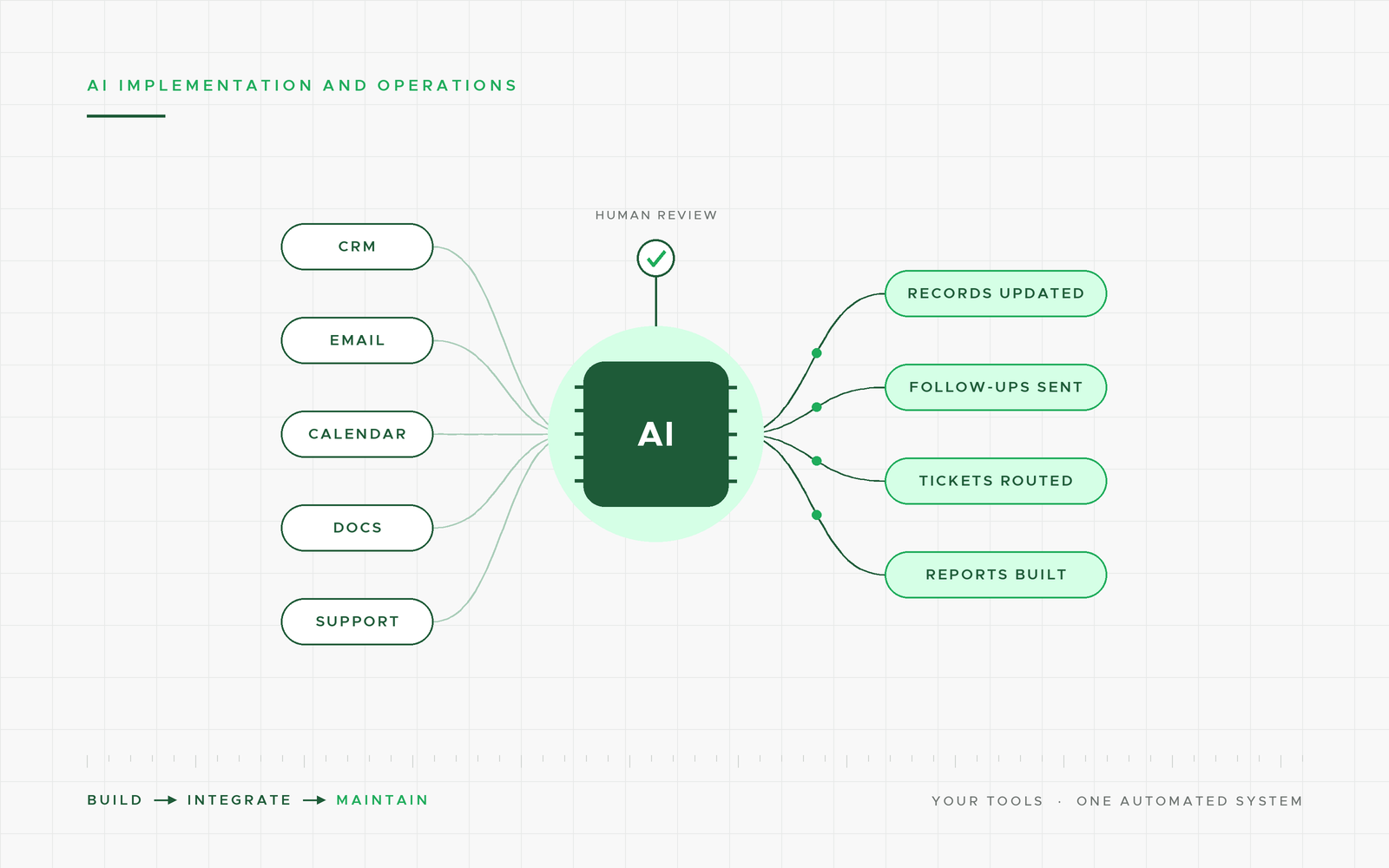


As your consulting and coaching partner, and fractional advisor, my team and I deliver the following expertise to build, integrate, and run AI systems that eliminate manual work across your business:

Automating repetitive, multi-step processes across sales, marketing, and operations with AI-assisted workflows in n8n, Zapier, or Make.
Building AI agents that research, draft, route, and follow up on tasks, with human approval points where judgment matters.
Embedding AI into HubSpot or Salesforce for lead scoring, record summaries, enrichment, and next-step recommendations.
Equipping reps with AI that researches prospects, builds account briefs, and drafts personalized follow-ups in minutes.
Building content pipelines that turn briefs into on-brand drafts for review, with your voice and guardrails built in.
Deploying AI that triages tickets, answers common questions from your knowledge base, and escalates the rest to people.
Pulling structured data from emails, PDFs, forms, and invoices directly into your CRM and business systems.
Capturing calls and meetings with AI transcription, summaries, and action items that update your CRM automatically.
Building AI-powered enrichment flows with tools like Clay and Apollo that keep contact and account data complete and current.
Engineering the production prompts, system instructions, and templates that make AI automations reliable and consistent.
Building internal assistants with custom GPTs and Claude Projects grounded in your documents, processes, and playbooks.
Connecting AI tools to your email, calendars, databases, and business apps through native integrations and APIs.
Designing approval steps, guardrails, and fallbacks so automated work stays accurate, compliant, and under your control.
Testing AI outputs before launch and monitoring them after, with alerts that catch errors before customers do.
Running and improving your AI systems over time, from tuning and maintenance to usage and cost control.
Delivering runbooks, SOPs, and training so your team can operate, troubleshoot, and extend what was built.

Your Current State: Your team spends hours every week copying data between tools, chasing status updates, and repeating the same manual steps — work that keeps the business running but never moves it forward.
Example Problem: Asana's Anatomy of Work Index found knowledge workers spend 60% of their time on "work about work" — chasing updates, switching between apps, and searching for information — instead of the skilled work they were hired to do.
Desired State: Repetitive, rules-based work handled by automated workflows with AI decision steps, so your people spend their time on customers, revenue, and judgment calls.
Example Outcome: In Asana's research, knowledge workers estimated that improved processes could save them 4.9 hours per week — more than six working weeks per person every year.
Your Current State: Your CRM, email, calendar, billing, and support tools each hold part of the picture, so people re-enter the same data in multiple places and nobody has a complete view of the customer.
Example Problem: MuleSoft's 2026 Connectivity Benchmark Report found the average organization runs 957 applications, yet only 27% of them are connected to each other.
Desired State: A connected tech stack where data flows automatically between systems through native integrations and APIs, with AI working across all of it instead of inside one silo.
Example Outcome: Microsoft's research on early AI assistant users found they were 27% faster at pulling together information from multiple sources — the kind of gain that only happens when tools and data are connected.
Your Current State: Your sales team spends more time researching accounts, writing emails, and updating records than actually talking to buyers — and pipeline suffers for it.
Example Problem: Salesforce's 2026 State of Sales report found the average seller spends just 40% of their time selling, with newer reps losing about two hours every week to manual data entry.
Desired State: AI sales assistants that research prospects, draft follow-ups, and update the CRM automatically, giving reps back the hours they need for real conversations.
Example Outcome: Sellers in the same Salesforce research expect AI agents to cut prospect research time by 34% and email drafting time by 36% — and top-performing teams are 1.7x more likely to use agents than struggling ones.
Your Current State: Your CRM is full of incomplete, outdated, and duplicate records because updating it is manual work nobody has time for — so forecasts, reports, and AI outputs are built on bad data.
Example Problem: Validity's 2025 research found 76% of CRM users say less than half of their organization's CRM data is accurate and complete, and its 2026 report found 62% of organizations lose revenue directly because of poor CRM data.
Desired State: CRM records that update themselves from calls, emails, and enrichment sources, with validation rules that catch errors before they spread into reports and AI tools.
Example Outcome: Validity's 2026 research found nearly 78% of C-suite leaders have acted on an AI recommendation they later suspected was wrong because of bad underlying data — clean, automated data capture is what makes AI recommendations safe to act on.
Your Current State: Inbound leads sit in an inbox or queue for hours or days before anyone follows up — and by then, many have already moved on to a faster competitor.
Example Problem: RevenueHero's 2024 test of 1,000 B2B sales teams found 63.5% never responded to an inbound inquiry at all, and those that did took about 29 hours on average.
Desired State: Automated lead capture, enrichment, routing, and first-touch follow-up that reaches every inbound lead within minutes, with a human taking over for qualified conversations.
Example Outcome: Harvard Business Review research found companies that contacted leads within an hour were nearly seven times more likely to qualify them than those that waited even an hour longer.
Your Current State: Your support team answers the same questions every day while complex issues wait in the queue, and customers expect faster answers than your team can deliver.
Example Problem: Zendesk's CX Trends 2026 research found 74% of consumers now expect support to be available around the clock, while Gartner reports traditional self-service resolves only about 14% of customer issues.
Desired State: AI support automation that triages tickets, answers routine questions from approved knowledge, and hands complex issues to people with full context.
Example Outcome: Gartner predicts agentic AI will autonomously resolve 80% of common customer service issues by 2029, leading to a 30% reduction in operational costs.
Your Current State: Calls and meetings happen all day, but notes are inconsistent, action items slip, and important details never make it into the CRM or project tools.
Example Problem: Microsoft's 2025 Work Trend Index found employees are interrupted every two minutes by meetings, emails, or chats, and 57% of meetings are ad hoc calls with no calendar invite.
Desired State: Meeting and call intelligence that transcribes conversations, captures decisions and next steps, and pushes them into your CRM and task systems automatically.
Example Outcome: In Microsoft's study of early AI assistant users, participants caught up on a missed meeting nearly four times faster, and 86% said it made catching up easier.
Your Current State: Policies, playbooks, pricing, and past decisions are scattered across drives, inboxes, and people's heads — so the same questions get asked and answered over and over.
Example Problem: Atlassian's State of Teams 2025 survey of 12,000 knowledge workers found teams waste 25% of their time searching for answers, and 56% still have to ping someone or schedule a meeting to get the information they need.
Desired State: Custom knowledge assistants grounded in your approved documents and processes, so anyone can get accurate answers in seconds without interrupting a colleague.
Example Outcome: In Microsoft's research on early AI assistant users, 75% said it saved them time by finding whatever they needed in their files.
Your Current State: Your team is experimenting with AI agents that can send emails, update records, or take actions — but nobody has defined their limits, approval points, or what happens when they get it wrong.
Example Problem: Gartner predicts over 40% of agentic AI projects will be canceled by the end of 2027 due to escalating costs, unclear business value, or inadequate risk controls.
Desired State: AI agents built around a defined job, with clear permissions, approval gates before customer-facing actions, and monitoring that catches problems early.
Example Outcome: Salesforce's 2026 State of Sales research found 94% of sales leaders using agents say they are critical for meeting business demands.
Your Current State: AI-generated emails, summaries, and content go out without anyone checking them — and errors, made-up facts, and off-brand messages end up in front of customers.
Example Problem: The University of Melbourne and KPMG's 2025 global study found 66% of employees rely on AI output without evaluating its accuracy, and 56% have made mistakes in their work because of AI.
Desired State: Quality controls built into every AI workflow — structured prompts, validation steps, and human review where accuracy matters most.
Example Outcome: The same study found 48% of employees report AI has increased revenue-generating activity — value that holds up when outputs are checked before they reach customers.
Your Current State: Your automations were built quickly and work most of the time, but they break when a tool changes, and fixing them pulls your most technical people away from other work.
Example Problem: MuleSoft's 2025 Connectivity Benchmark Report found IT teams spend 39% of their time creating custom integrations and automations.
Desired State: Automations designed for reliability from the start — documented, tested, monitored with alerts, and built on platforms your own team can maintain.
Example Outcome: MuleSoft found 65% of organizations now have complete or near-complete strategies for enabling non-technical users to build automations with low-code tools — the foundation for systems your team can own.
Your Current State: You have bought AI tools, but they can't see your CRM, documents, or customer history — so they produce generic output your team has to rewrite by hand.
Example Problem: MuleSoft's 2025 Connectivity Benchmark Report found 95% of IT leaders report integration as a hurdle to implementing AI effectively.
Desired State: AI connected securely to the systems and data it needs, with the right permissions, so its output reflects your actual customers, products, and processes.
Example Outcome: MuleSoft's 2026 research found 86% of IT leaders agree that without proper integration, AI agents introduce more complexity than value — which is why connecting the data comes first.
Your Current State: AI subscriptions and add-ons keep appearing on expense reports and invoices, usage-based charges are hard to predict, and nobody knows which tools are actually delivering value.
Example Problem: Zylo's 2026 SaaS Management Index found spending on AI-native applications jumped 108% in a year, while expense-based software purchases rose 267% — with ChatGPT now the most expensed app.
Desired State: A managed AI stack with clear ownership, usage monitoring, consolidated tools, and cost controls tied to the business value each tool delivers.
Example Outcome: The same Zylo research found organizations leave an average of 36% of their software licenses unused — spend that can be reclaimed once tools are consolidated and governed.
Your Current State: The person who built your automations is the only one who knows how they work — so when they are out, busy, or gone, nobody can fix, change, or extend them.
Example Problem: Panopto's Workplace Knowledge and Productivity Report found 42% of institutional knowledge is unique to the individual employee — meaning colleagues can't do that part of the job when the person is unavailable.
Desired State: Every automation documented with runbooks and SOPs, multiple trained owners, and a clear support and escalation plan.
Example Outcome: The same research found knowledge workers waste 5.3 hours every week waiting for information from colleagues or recreating knowledge that already exists — time that documentation and proper handoff give back.

Choose the approach to our partnership that best suits your needs.
Best for a strategic deep-dive before a full build—I'll audit your full go-to-market motion and deliver a diagnostic with recommendations.

Best suited for targeted projects—I'll provide focused guidance and custom strategies to solve your specific challenges.
Ideal for ongoing support—I'll act as your part-time expert to drive sustained growth.
Best for tailored growth in personal or business areas—I'll guide you to build systems for excellence with a DIY approach based on your needs.

Andrei Trapizonian is professional, kind, and incredibly driven. Working with him has made a real difference in how we run our sales operations. He helped me create clear sales stages tailored to our buying journey as we scaled with multiple salespeople and coaches. By optimizing our CRM and PandaDoc processes, he improved efficiency, boosted data accuracy, and elevated the quality of our proposals. Reporting and analytics, which used to feel overwhelming, are now straightforward and reliable. Andrei’s guidance has been practical, motivating, and exactly what we needed to build a stronger foundation for growth.


As someone who has worked with Andrei on various coaching engagements, I can confidently say that his approach towards achieving well-rounded excellence is both practical and effective. Starting from college admissions and student success, our sessions naturally progressed to discussions around productivity, performance, wellness, and other aspects that go into personal and professional growth. With his guidance, I was able to secure a job and negotiate the terms of my contract with my employer, positioning myself as a valuable asset in the marketplace. His advice on time management, accountability, and goal-setting also helped me significantly increase my productivity and find balance with my wellness and other responsibilities. Reading his blog and newsletter continues to inspire me to become a more well-rounded and successful individual.


Partnering with Andrei Trapizonian Global consultancy elevated my brand at GPRGIS Tech Solutions—their expertise polished my marketing messaging across internal narratives, website content, presentations, collateral, and social media, crafting a cohesive story that resonates with the market. We worked collaboratively on formulating the most effective ways to communicate our value proposition across various channels, ensuring a unified voice. This effort resulted in new client wins and a noticeable boost in brand awareness, evidenced by increased inbound requests, strengthening our market leadership.

Andrei's coaching and membership have been instrumental in helping me achieve well-rounded excellence. We were able to optimize these three key areas I wanted to focus on: productivity, fitness, and personal security. In terms of productivity, Andrei helped me optimize my schedule and manage my commitments, enabling me to get more done in less time. When it came to fitness, he provided me with invaluable advice on nutrition, supplementation, and workout programs, which helped me make significant progress towards my fitness goals. Finally, his insights on personal security were invaluable in helping me navigate the various challenges that come with being an entrepreneur. Thanks to Andrei's coaching and membership, I have been able to achieve more than I ever thought possible.
Discover authentic testimonials from clients who have grown their business and commanded impactful professional performance with our systems - start getting similar results today.
.jpg)

Personalized business and executive performance solutions tailored to your specific needs, goals, and preferences.
If you have a particular challenge or skill you want to develop personally, or specific business process to improve, we will work with you to address that need and equip you with tailored tools and strategies to succeed.
If you are looking to elevate and enhance multiple areas of your executive performance and business operations, we will guide you in creating a plan that ensures consistency and balance across those domains.
If you are seeking a complete transformation, we’ll support you in building a complete program for professional & revenue growth tailored to your aspirations.
We design winning systems for commercial excellence that create lasting impact in your business while empowering you to grow professionally.

More resources & tools to enable your success in achieving sustainable revenue growth.

Stay ahead with strategic insights on business growth, revenue systems, sales performance, and executive leadership — delivered directly to your inbox.

Connect with a growing network of business owners, founders, and professionals committed to building smarter systems and driving sustainable growth.

Get first access to new content, frameworks, event announcements, and behind-the-scenes perspectives from Andrei Trapizonian Global.

Access an expanding library of expert-led sessions covering GTM strategy, sales systems, revenue operations, leadership, and high-performance habits.

Browse a curated collection of articles, videos, frameworks, and guides covering business performance, sales strategy, and executive leadership.

Access practical tools, templates, and frameworks designed to help you optimize revenue systems, improve operational efficiency, and perform at your highest level.
