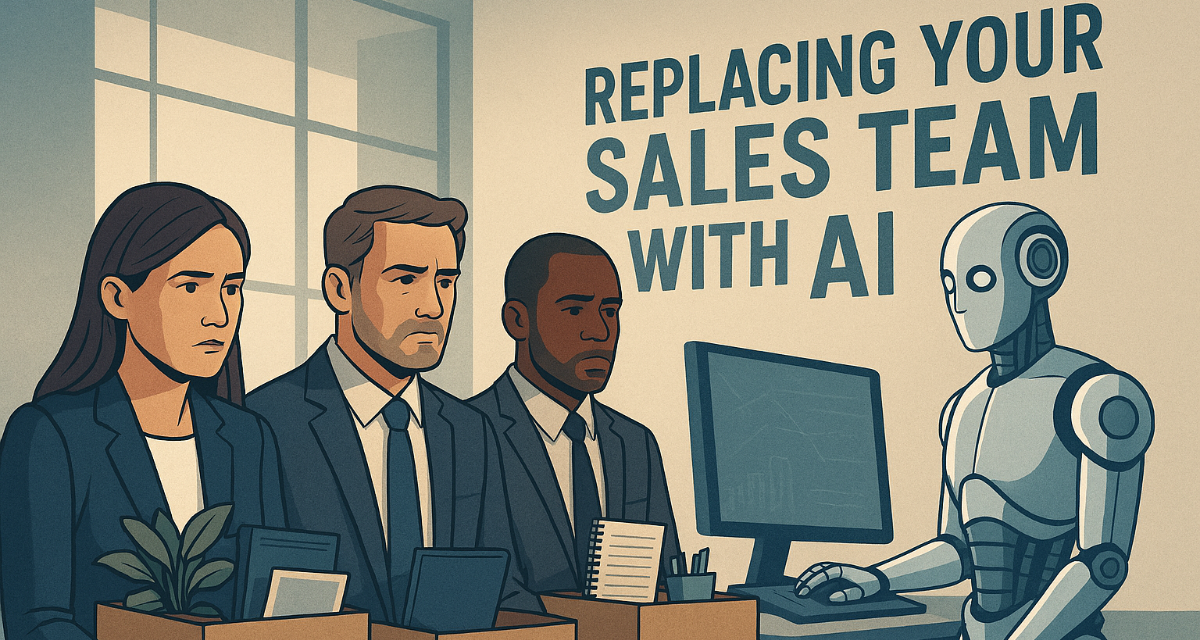
The narrative that AI will replace your sales team isn't just wrong — it is actively destroying the revenue engines of the companies that believe it most aggressively. Here is what the data actually shows, and what the smartest organizations are doing instead.
Lorem ipsum dolor sit amet, consectetur adipiscing elit proin mi pellentesque lorem turpis feugiat non sed sed sed aliquam lectus sodales gravida turpis maassa odio faucibus accumsan turpis nulla tellus purus ut cursus lorem in pellentesque risus turpis eget quam eu nunc sed diam.
Lorem ipsum dolor sit amet, consectetur adipiscing elit proin mi pellentesque lorem turpis feugiat non sed sed sed aliquam lectus sodales gravida turpis maassa odio.

Lorem ipsum dolor sit amet, consectetur adipiscing elit consectetur in proin mattis enim posuere maecenas non magna mauris, feugiat montes, porttitor eget nulla id.
Lorem ipsum dolor sit amet, consectetur adipiscing elit ut suspendisse convallis enim tincidunt nunc condimentum facilisi accumsan tempor donec dolor malesuada vestibulum in sed sed morbi accumsan tristique turpis vivamus non velit euismod.
“Lorem ipsum dolor sit amet, consectetur adipiscing elit nunc gravida purus urna, ipsum eu morbi in enim”
Lorem ipsum dolor sit amet, consectetur adipiscing elit ut suspendisse convallis enim tincidunt nunc condimentum facilisi accumsan tempor donec dolor malesuada vestibulum in sed sed morbi accumsan tristique turpis vivamus non velit euismod.
There is a narrative spreading through boardrooms, investor decks, and startup Slack channels that sounds compelling on the surface: artificial intelligence is coming for your revenue team. Cut the headcount. Automate the pipeline. Let the bots handle customer success. Watch your margins expand.
It is also, in measurable and documented ways, destroying the revenue engines of the companies that believe it most aggressively.
This is not a defense of inefficiency. AI has a legitimate and powerful role in modern revenue operations. But the distinction between deploying AI as an amplifier versus deploying it as a replacement is not semantic — it is the difference between building a competitive advantage and quietly burning your market.
The logic is seductive. A $40 per month AI outreach tool versus a $100,000 enterprise SDR looks like a straightforward financial decision. A bot that handles tier-one customer support tickets versus a $70,000 customer success manager seems obvious when margins are under pressure.
But this math has a critical missing variable: the cost of what breaks when the human leaves.
Revenue teams do not just execute tasks. They carry institutional knowledge, relationship context, and the social intelligence required to navigate the complexity of real commercial interactions. When you strip that out in favor of automation, you are not simply replacing one function with a cheaper version of itself. You are changing the fundamental nature of how your business interacts with the market — and the market notices before your dashboards do.
The delay between the decision and the consequence is precisely what makes this mistake so dangerous. Churn does not spike the week you cut your CS team. Pipeline does not collapse the month you replace your SDRs with an AI sequence tool. The damage accumulates quietly, in renewal conversations that feel slightly off, in enterprise deals that stall without explanation, in domains that start delivering to spam folders instead of inboxes.
By the time the data shows the problem clearly, the damage is already structural.
One of the most technically concrete ways AI outreach destroys revenue is through what deliverability experts call the domain reputation death spiral — and it is happening to companies at scale right now.
The promise of AI-powered outbound is volume. Send more sequences, reach more prospects, book more meetings. What the pitch decks leave out is the infrastructure reality underneath.
Most AI sales platforms operate on shared sending infrastructure. When one user on that infrastructure sends sequences with high bounce rates, aggressive follow-up cadences, or spam-triggering copy, the IP reputation for the entire pool degrades. Google and Microsoft have become significantly more aggressive in their filtering, with bounce rates above 2% triggering deliverability penalties that cascade across your sending domain.
The compounding effect is where it becomes catastrophic. Once your AI SDR tool has damaged your domain reputation, the problem does not stay contained to the AI-generated sequences. Your account executives' manually written emails — the ones going to warm prospects, existing customers, and active opportunities — begin landing in spam folders too. You have not just hampered your outbound motion. You have contaminated your entire commercial communication channel.
You are not scaling your pipeline. You are burning your total addressable market, and you are doing it at machine speed.
The human SDR who sent 50 personalized emails per day was never going to cause this problem. The AI tool sending 5,000 was always going to.
Customer success is where the AI replacement argument tends to feel most reasonable. Ticket routing, FAQ responses, onboarding sequences, health score monitoring — these all have legitimate automation applications. The mistake is extrapolating from those use cases to the conclusion that the human relationship itself is replaceable.
Gartner's research predicts that by 2027, 50% of organizations that set out to reduce customer service headcount through AI will reverse that decision — not because the technology failed technically, but because the business outcomes failed commercially.
The mechanism is what behavioral researchers call the Uncanny Valley effect applied to commercial relationships. When a customer interacts with a system that is almost human but not quite — responses that are grammatically correct but emotionally flat, support interactions that resolve the ticket without acknowledging the frustration behind it — the dissonance registers subconsciously even when the customer cannot articulate it explicitly.
These customers do not file complaints. They do not open escalation tickets. They simply make a different decision at renewal. They downgrade quietly. They choose a competitor at the next budget cycle without giving you a chance to respond.
The reason this does not show up in standard CS metrics is precisely because nothing technically went wrong. The ticket was resolved. The response time was within SLA. The CSAT score was neutral. But the relationship eroded, and the churn was inevitable long before any dashboard showed it.
You can automate a password reset. You cannot automate the judgment required to recognize that an angry VP threatening cancellation on a $50,000 contract needs to hear a human voice within the hour, not a chatbot response within four minutes.
The case for AI replacement weakens further as deal complexity increases — and nowhere is this more apparent than in enterprise B2B sales.
By 2030, Gartner research projects that 75% of B2B buyers will prefer human interaction for complex, high-stakes purchases — a counterintuitive finding in an era of digital-first buyer behavior. The reason is structural: enterprise sales are not fundamentally about information transfer. They are about politics, risk mitigation, organizational trust, and the navigation of complex multi-stakeholder buying committees.
An AI can draft a compelling executive summary. It cannot read the body language shift when a CFO's interest moves from skeptical to cautiously engaged during a live negotiation. It cannot leverage the relationship built over three years of quarterly reviews to get a deal unstuck when procurement introduces a last-minute objection. It cannot take a buying committee to dinner the week before a board vote and use that human context to understand what the deal actually needs to close.
Enterprise deals close on relationships that were built long before the opportunity was created in your CRM. The AI tools that support those relationships — research, preparation, follow-up drafts, risk scoring — are genuinely valuable. The notion that the relationship itself can be automated is not supported by how enterprise buying actually works.
The companies building durable revenue advantages with AI are not asking how many humans they can remove from the equation. They are asking a fundamentally different question: how do we make each human on our revenue team dramatically more effective than they could be without AI support?
The distinction in practice is significant.
Instead of having AI write and send cold outreach sequences autonomously, deploy it to research accounts, analyze 10-K filings, identify trigger events, and draft three opening hooks for your SDR to select and personalize. The human judgment stays in the loop. The AI handles the research that used to take two hours per account.
Instead of having AI conduct discovery calls, deploy it to listen in real time and surface relevant information — objection handling frameworks, competitive intelligence, pricing context — as coaching cards visible to the rep during the conversation. The human leads the relationship. The AI makes them the most prepared person in the room.
Instead of having AI manage customer renewals, deploy it to analyze product usage patterns, identify early churn signals, and flag at-risk accounts for your CSM to prioritize. The human builds the relationship that retains the customer. The AI ensures they are never surprised by an account that was quietly disengaging for six months.
This is not a compromise position. It is a competitive advantage. The organizations that figure out how to build genuinely AI-augmented human revenue teams will outperform both the companies still operating entirely on human capacity and the companies that automated themselves out of the relationships that drive commercial outcomes.
There is a broader market dynamic at work that the pure automation argument consistently misses.
As AI-generated communication becomes more prevalent, the signal value of genuine human engagement increases proportionally. When every company in your competitive set is sending AI-generated sequences, the handwritten follow-up email stands out more than it ever did. When every SaaS vendor offers a chatbot, the company whose CSM calls proactively creates a differentiated experience.
The market is not static. Buyer behavior adapts to the environment it operates in. In an environment saturated with automated interaction, human connection becomes a premium signal — not because buyers are sentimental, but because human judgment, accountability, and genuine relationship-building actually produce better commercial outcomes in complex buying situations.
The winners of the next decade of commercial competition will not be the organizations with the fewest humans in their revenue motion. They will be the organizations with the most effective humans — people whose judgment, relationships, and commercial intelligence are amplified by AI tools rather than replaced by them.
The goal was never to build a robot. The goal was always to build a better pilot.
Artificial intelligence is one of the most significant productivity and capability tools available to revenue organizations today. The question is not whether to use it — the question is whether you deploy it with the strategic clarity to understand what it can and cannot replace.
Trust cannot be automated. Judgment cannot be scaled through a shared IP pool. The relationship that closes a $500,000 enterprise deal or saves a $50,000 renewal is built through human interaction across months or years. AI can support every stage of that process. It cannot substitute for the process itself.
Stop trying to automate trust. Build better humans instead — and give them the best tools in the world to do their jobs.
• Validity. Email Deliverability Benchmark Report. validity.com
• Gartner. Three Technologies That Will Transform Customer Service and Support by 2028. gartner.com
• Gartner. B2B Buying Journey Research. gartner.com

.svg)

.svg)